- Local pain
- Referred pain (pain felt in another area)
- Muscle stiffness
- Restricted movement
- Relaxes the tight muscle band
- Provides immediate pain relief
- Interrupts the pain-spasm cycle
- Reduces inflammation
- Provides longer-lasting relief
- Mechanical disruption of the trigger point
- Stimulates muscle relaxation
- Improves blood flow
- Immediate muscle relaxation (anesthetic)
- Long-term inflammation control (steroid)
- Breaks the pain-spasm-pain cycle
Trigger point injections are used for muscle-related pain conditions such as:
- Myofascial pain syndrome
- Neck and shoulder pain
- Upper and lower back pain
- Tension-type headaches
- Fibromyalgia-related focal trigger points
- Muscle strain or overuse injuries
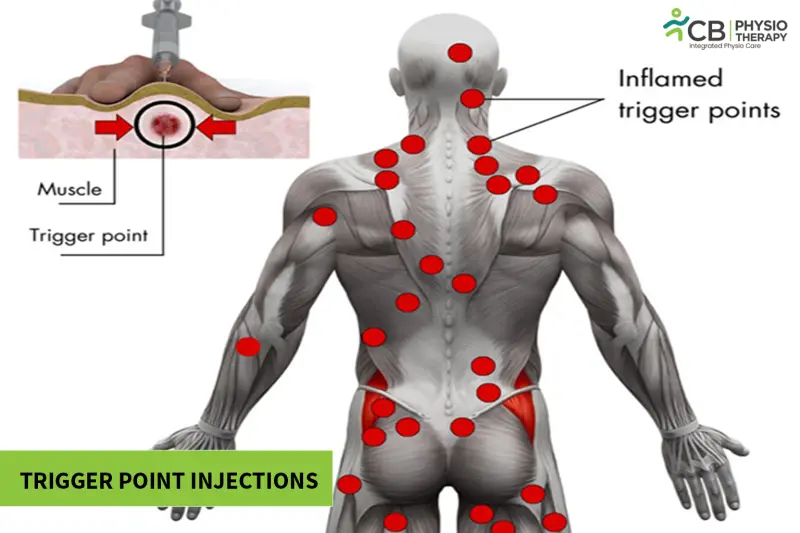
A trigger point injection works by relaxing the contracted muscle fibers and restoring normal blood flow.
- Disrupts the tight muscle knot
- Blocks pain signals temporarily (anesthetic effect)
- Reduces local inflammation (if steroid used)
- Improves oxygen supply to muscle
- Breaks the pain cycle
EXACT PROCEDURE
(STEP-BY-STEP)
Trigger point injection is a quick outpatient procedure performed under sterile precautions.
- Patient positioned comfortably
- Painful trigger point identified by examination
- Skin cleaned and sterilized
- Small needle inserted into the trigger point
- Medication injected into the tight muscle band
- Needle removed and small dressing applied
Procedure time: 5–15 minutes
Observation time: 10–20 minutes
Same-day discharge
During the procedure:
- Mild needle prick
- Brief muscle twitch response (common and normal)
- Temporary pressure or cramping sensation
After the procedure:
- Immediate soreness at injection site (may last 1–2 days)
- Muscle relaxation
- Improved range of motion
- Pain relief within minutes (if anesthetic used)
- Steroid effect begins in 1–3 days (if used)
Most patients tolerate the procedure very well.
The number of injections depends on:
- Number of trigger points
- Duration of symptoms
- Response to the first injection
- Some patients improve after one session
- Others may require a series of injections
- Typically spaced 1–3 weeks apart if repeated
It ultimately depends on clinical response and functional improvement.
Is the procedure safe?
Yes, when performed by a trained healthcare professional using sterile technique.
Possible minor side effects:
- Temporary soreness
- Bruising
- Mild swelling
- Temporary numbness
Serious complications are very rare.
The main goal is to relieve muscle spasm and restore normal movement.
- Reduces muscle tightness
- Improves flexibility
- Decreases pain intensity
- Enhances daily function
- Facilitates participation in physiotherapy
- Improves quality of life
Trigger point injections are used for muscle-related pain conditions such as:
- Myofascial pain syndrome
- Neck and shoulder pain
- Upper and lower back pain
- Tension-type headaches
- Fibromyalgia-related focal trigger points
- Muscle strain or overuse injuries
Although generally safe, certain situations require caution.
Absolute:
- Active skin infection at injection site
- Bleeding disorder
- Allergy to medication
- No patient consent
Relative:
- Uncontrolled diabetes (if steroid used)
- Pregnancy
- Severe systemic illness
- Anticoagulant therapy
Pain relief alone does not correct:
- Poor posture
- Muscle imbalance
- Weakness
- Movement dysfunction
- Repetitive strain patterns
After pain reduces, physiotherapy helps:
- Strengthen weak muscles
- Improve flexibility
- Correct posture
- Restore normal biomechanics
- Prevent recurrence
- Achieve long-term results
Trigger point injections are most effective when combined with a structured rehabilitation program.