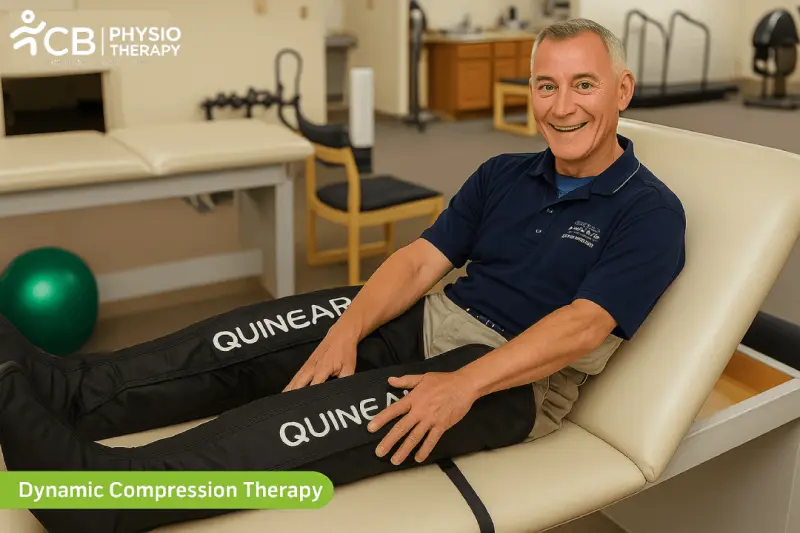
Dynamic Compression Therapy (DCT) also known as
Intermittent Pneumatic Compression (IPC) or Sequential Compression Therapyis a
therapeutic technique that uses an external pneumatic device to apply
intermittent, rhythmic, and sequential pressure to a limb (usually arms or
legs).
It is different from static compression (like
stockings or bandages), because instead of providing constant pressure, the
device alternates cycles of inflation and deflation. This mimics the natural
“muscle pump” of the body and helps circulation.
In physiotherapy, we always need clear treatment
parameters to set up Dynamic Compression Therapy (DCT / IPC) safely and effectively.
Here are the standard treatment parameters:
Inflation Pressure:
General range: 30 – 120 mmHg
For venous disorders / DVT prevention: 40 – 60 mmHg
For lymphedema: 30 – 60 mmHg (low to moderate)
For post-traumatic / post-surgical edema: 40 – 70 mmHg
For healthy athletes (recovery): 60 – 100 mmHg (higher
tolerated)
Pressure should not exceed patient’s diastolic BP.
Inflation / Deflation Cycle:
Inflation time: 30 – 60 seconds
Deflation time: 20 – 30 seconds (or until limb
refills)
Sequential chambers: Distal → Proximal wave-like
inflation
Total Treatment Time:
Typical session: 20 – 45 minutes
Lymphedema / chronic edema: 45 – 60 minutes
Sports recovery / DVT prevention: 20 – 30 minutes
Frequency:
1–2 times daily (medical use)
After training sessions (athletes)
Limb Position
Limb should be slightly elevated above heart level to
assist drainage.
Number of
Chambers
Devices usually have 3–12 chambers.
Sequential multi-chamber devices are more effective
than single-chamber (uniform compression).
Monitoring
Check skin color, temperature, capillary refill, and
sensation throughout.
Stop immediately if patient reports pain, numbness, or
discomfort.
Here’s a clear breakdown of how Dynamic Compression
Therapy (DCT) works:
Device setup
A special sleeve, boot, or garment with multiple air
chambers is placed around the limb (leg or arm).
The device is connected to a pump that controls air
pressure.
Inflation phase (Compression)
The pump inflates the sleeve sequentially from distal
to proximal (e.g., foot → calf → thigh).
This creates a wave-like squeezing motion, similar to
how muscles contract and push blood upward during movement.
The pressure temporarily narrows veins and lymph
vessels, forcing fluid to move out of tissues and toward the heart/lymph nodes.
Deflation phase (Relaxation)
After a set time, the chambers deflate.
This releases pressure, allowing blood vessels and
lymphatics to refill from surrounding tissues.
Cycle repetition
The inflation–deflation cycle repeats multiple times
per session.
The repeated cycles improve:
Venous return (blood flow back to the heart)
Lymphatic drainage (removal of waste, proteins, and
excess fluid)
Microcirculation (delivery of oxygen and nutrients to
tissues)
Positive Sensations
Reduced heaviness, tightness, or swelling.
Feeling of improved circulation / warmth in the limb.
In athletes → legs feel lighter and refreshed after
recovery sessions.
When It Feels Uncomfortable (Red Flags)
Pain or sharp pressure → may mean pressure is too
high.
Numbness, tingling, or coldness → indicates impaired
circulation.
Skin turning pale, blue, or blotchy → stop
immediately.
The number of Dynamic Compression Therapy (DCT / IPC)
sessions depends on the condition being treated, the severity, and whether it’s
for medical management or sports recovery.
Short-term issues (post-injury or surgery): Usually 5–15
sessions until swelling reduce.
Chronic conditions (lymphedema, venous disease): Long-term
or ongoing therapy may be needed for maintenance.
Sports recovery: Used as needed, often 2–4 times per
week during training season.
Prevents pooling of blood in legs/arms
Reduces swelling and edema
Enhances oxygen delivery and waste removal
Decreases risk of clot formation (DVT)
Promotes faster tissue healing and recovery
Dynamic Compression Therapy (DCT) can benefit a wide
range of people, both medically and in sports/rehabilitation.
Medical /
Clinical Use:
Patients with venous disorders
Chronic venous insufficiency
Post-thrombotic syndrome
Patients with swelling (edema)
Post-surgical swelling
Post-traumatic swelling (after fractures, ligament
injury, etc.)
Lymphedema patients
After cancer treatment (e.g., mastectomy with lymph
node removal)
Chronic lymphatic obstruction
Immobile or bedridden patients
For prevention of deep vein thrombosis (DVT) in
hospitals or after surgery
Sports &
Recovery Use:
Athletes after training/competition
To reduce muscle fatigue and soreness
To accelerate recovery by improving circulation and
flushing out lactic acid/waste
Fitness enthusiasts
For faster recovery after intense workouts
Rehabilitation / Physiotherapy Use:
Post-orthopedic surgeries(knee/hip replacement, ligament
repair) to manage swelling
Chronic pain patientswhere swelling and poor circulation
worsen symptoms
Neurological patients (with reduced mobility leading to leg
swelling)
Dynamic Compression Therapy (DCT) is used in both
medical treatment and sports recovery.
Here’s a clear list of conditions it helps treat:
Vascular & Circulatory Conditions
Chronic Venous Insufficiency (CVI) – improves venous
return, reduces heaviness and swelling.
Varicose veins – relieves discomfort, improves
circulation.
Deep Vein Thrombosis (DVT) prevention – in immobile,
bedridden, or post-surgical patients.
Peripheral vascular disorders – where circulation is
sluggish.
Edema & Swelling
Post-surgical edema – after orthopedic, plastic, or
vascular surgeries.
Post-traumatic edema – swelling after fractures,
ligament injuries, or sprains.
Chronic leg swelling from poor circulation or
immobility.
Lymphatic Conditions
Lymphedema (primary or secondary, e.g., after
mastectomy, pelvic cancer surgery, or radiation therapy).
Lymphatic obstruction – to promote drainage and reduce
limb heaviness.
Sports & Rehabilitation
Athletic recovery – reduces muscle soreness, speeds up
recovery after intense training/competition.
Post-exercise muscle fatigue – flushes out metabolic
waste, enhances oxygen delivery.
Injury rehabilitation – controls swelling after
sprains, ligament tears, or joint surgeries.
Other Uses
Bedridden / ICU patients – for DVT prophylaxis.
Neurological patients with immobility (e.g., stroke,
spinal cord injury) – to prevent venous stasis and swelling.
Dynamic Compression Therapy is mainly used to treat
venous insufficiency, lymphedema, post-surgical or post-injury swelling, DVT
prevention, and to enhance athletic recovery.
Here’s a clear list of contraindications for Dynamic Compression Therapy (DCT / Intermittent Pneumatic Compression):
Absolute Contraindications (Should NOT be used)
Acute Deep Vein Thrombosis (DVT) → risk of dislodging
the clot.